Open Source

A West African Perspective on Open Source

Growing up in Nigeria, Kayode Odusote liked figuring out how things work. As a young boy, he would often purchase Radio Shack do-it-yourself kits and assemble them.

Years later he became a neurologist and professor, and more recently served as director for human resources development at the West African Health Organization (WAHO). WAHO is an umbrella organization of 15 member countries, and one of Professor Odusote’s key aims was to help these countries gather and use health worker data to inform their decisions. But this wasn’t easy. “We found that none of them had the kind of human resources information system that they could use for planning,” he recalls.

Working with limited resources, he wanted to avoid installing systems that relied on proprietary software, which entails various fees for licensing, upgrades, and customization. “With proprietary products,” he explains, “the vendor controls the costs.” He has stories of proprietary applications developed by vendors in Burkina Faso and Togo; the computers they were built for became outdated and the applications could not be updated to match current operating systems of new, donated computers. They became useless.
Read more »

Advocating Open Access: Information Has the Power to Save Lives

This post was originally published on the IntraHealth International blog.

To mark tCorinne Farrellhe beginning of Open Access Week, a global event now in its fifth year, which promotes open access as a new norm in scholarship and research, we started thinking about the concept of “open.” Google defines it as:

Allowing access, passage, or a view through an empty space; not closed or blocked up: ‘the door was wide open.’

IntraHealth has long championed the importance of health workers and managers having open access to information, particularly in developing countries. Open access is a natural extension of that work. As we blogged last spring, readily available and accessible information can help health workers save lives. Read more »

iHRIS: A Year of Development

Carol BalesWe know that most “year in review” articles are published in January, coinciding with the new calendar year, but the year that’s been consuming our thoughts just ended. CapacityPlus’s second fiscal year wrapped up in June and, since we’ve been concentrating on iHRIS development over the last year for our year-end reporting, we thought we’d post a summary of our accomplishments.

Following the “release early, release often” philosophy that encourages user feedback, we published 11 new releases of our iHRIS Qualify and iHRIS Manage software. We added new capabilities focused on improving the usability of the software, expanding translation support, enhancing our reporting module for data analysis and use, and, of course, fixing bugs. Read more »

Only Human: The Challenge of Intentional Knowledge Management

Corinne FarrellThe last week was a bit of a whirlwind, as I spent Thursday and Friday in Washington, DC at the KM Impact Challenge unConference. There, I shared CapacityPlus’s experiences measuring the success of the HRH Global Resource Center.

I left the conference holding a stack of new contacts’ business cards and brainstorming uses for network analyses. I said to myself, on Monday I’ll tell my colleagues all about the unConference. Then my return flight was delayed. I got home late, rose early, spent hours at the emergency room with my three-year-old getting stitches, cleaned my house, came to work on Monday, filled out an expense report, wrote a trip report, sorted through 400 unread e-mails, and my “to do” list exploded. Read more »

Open Access: The Only Viable Option for Change

Rebecca RhodesWhy do we publish health research? If the editors of PLoS Medicine are correct that “medical journals have many roles, but, above all, dissemination of medical information is key,” then journals need to be accessible to the most important data consumers—frontline health workers.
While research for its own sake is necessary to advance scientific understanding, this is not enough. At its core health development research should save the lives of people who—without access to basic health care—die from diseases easily cured or preventable childbirth complications.

Impact
If the individuals who could most contribute to and benefit from information on health in the developing world find the resources cost-prohibitive to access, then how much impact can we really expect from research? Read more »

Developer to Developer: Creating a Regional Support Network at the Unconference

Read about the first days of the Unconference.

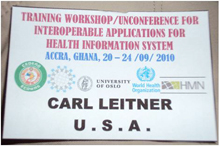
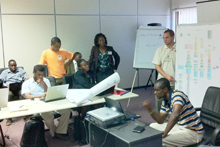
Carl Leitner at the unconference, GhanaClosing the iHRIS track on Tuesday, CapacityPlus staff Dykki Settle asked how many of the participants were excited to come back tomorrow. In reply, the 25 participants—from Sierra Leone, Ghana, Mali, Burkina Faso, Nigeria, Togo, and more—including human resources (HR) managers, information technology staff, and HR directors—universally and sincerely expressed their enthusiasm for the Training Workshop/Unconference for Interoperable Applications for Health Information Systems. As this is a western African regional conference, both French and English speakers were present. Many thanks to Romain Tohouri who provided excellent translation to and from French on technical areas such as HR and software development, as well as health sector terminology. Read more »

The Digital Nomad: Blogging from the Health Information Systems Unconference

Carl Leitner's badgePacked and ready to collaborate
In my suitcase there are two iHRIS Appliances, a host of books donated by O'Reilly, and several large printouts of the form maps for iHRIS Manage and iHRIS Qualify. I’m a digital nomad, I say to myself, looking at my backpack full of electronic knick-knacks that will help smooth over any technical hiccups we may encounter during the Training Workshop/Unconference for Interoperable Applications for Health Information Systems. Held in Accra, Ghana, most participants are from the Economic Community of West African States, with several iHRIS developers from Botswana and Lesotho as well. Read more »

Syndicate content