Kenya

Building the Workforce to Help Orphans and Vulnerable Children

Maurice MiddlebergShe’s 14 years old and HIV-positive. She has been taking ARVs her whole life but no one told her why she was taking medications. She finally confronted the doctors and asked for an explanation as to why she was taking the pills. The doctors answered her questions. She then had something of a crisis and became quite depressed. We have been working with her and we’re very happy because she seems to have recovered. You can see she is back playing with the other children and smiling again.”

This story was told to me during a recent visit to Haiti by a staff member at an NGO working with orphans and vulnerable children (OVC). It is a poignant reminder of the terrible costs of the HIV pandemic, which has created a large number of children who have lost a parent or live in a household with a seriously ill adult. In Haiti there are more than a million such children. This problem was exacerbated by the January 2010 earthquake, which resulted in an additional 150,000 orphans.

The needs of OVC extend beyond health services to include mental health care, schooling, food and nutrition, shelter, and protection from abuse and exploitation. The clinician or community health worker is usually ill-prepared to arrange and integrate the array of services needed by OVC. These are the skills of the social worker. Read more »

Move the Merchandise: An Around-the-Clock Operation to Save a Kenyan Medical Warehouse

Wambua NziokiThis post was originally published on the IntraHealth International blog.

Picture the following scenario: A large warehouse, 13,000 square meters, on the outskirts of Nairobi, Kenya, about 20 kilometers from the city center, is so full of drugs and other medical supplies that there is no space for new deliveries. The warehouse is packed with everything from gauze bandages to malaria pills to antiretroviral drugs—valuable and necessary medical supplies that people need. But the system used to manage and distribute these supplies with less paperwork and greater efficiency, known as the Enterprise Resource Planning system, is not working. This means nothing is moving in or out of the warehouse. Read more »

Retaining Health Workers in Rural Kenya: What We Can Learn from Other Countries

This is an excerpt from an original post on the IntraHealth International blog.

Achim ChiajiIn the northern arid lands and other remote parts of Kenya, the Capacity Kenya project has been working with the Ministry of Health to design simple packages to attract health workers and encourage them to stay. Starting with a selected list of diverse pilot sites, the project set out to design intervention packages, implement them, and systematically evaluate their impact on health worker retention over time.

A couple of weeks ago I attended the Second Global Forum on Human Resources for Health in Bangkok, which gave me a unique opportunity to learn about the struggles, successes, and constraints of other countries. As I listened to the experiences of others and what they see as best practices, I kept thinking about what new interventions might work best in the Kenyan context. Read more »

iHRIS in Kenya—The Key to Long-Term Sustainability

Brooke BuchananThe human resources information system (HRIS) implementation team for Capacity Kenya has championed the use of iHRIS software in Kenya. Because of their efforts we are excited to soon have a fully integrated system for human resources for health policy, planning, and management throughout the country.
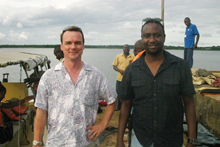
Dr. Samwel Wakibi is now collaborating with the Ministry of Health and the Ministry of Public Health and Sanitation to ensure all human resources data for hiring, transferring, and retiring health workers are electronically entered into iHRIS by the Complement Section—the part the Human Resources Division within the Ministry of Health that handles all status changes for employed health workers, then sends these change orders to the Ministry of Public Service and then on to payroll. Read more »

From Human Resources for Health to Visiting Uganda’s Natural Resources

Erik Reavely and George Mgomella

As part of the CapacityPlus work with stakeholder leadership groups, I traveled to Kenya and Uganda for two weeks in April.

Together, George Mgomella, from associate partner the African Population and Health Research Center, and I interviewed 22 members of the Health Workforce Observatory in Kenya and the Health Workforce Advisory Board in Uganda about their experience in these stakeholder leadership groups. Read more »

Syndicate content