HR Information Systems

A West African Perspective on Open Source

Growing up in Nigeria, Kayode Odusote liked figuring out how things work. As a young boy, he would often purchase Radio Shack do-it-yourself kits and assemble them.

Years later he became a neurologist and professor, and more recently served as director for human resources development at the West African Health Organization (WAHO). WAHO is an umbrella organization of 15 member countries, and one of Professor Odusote’s key aims was to help these countries gather and use health worker data to inform their decisions. But this wasn’t easy. “We found that none of them had the kind of human resources information system that they could use for planning,” he recalls.

Working with limited resources, he wanted to avoid installing systems that relied on proprietary software, which entails various fees for licensing, upgrades, and customization. “With proprietary products,” he explains, “the vendor controls the costs.” He has stories of proprietary applications developed by vendors in Burkina Faso and Togo; the computers they were built for became outdated and the applications could not be updated to match current operating systems of new, donated computers. They became useless.
Read more »

iHRIS: A Year of Development

Carol BalesWe know that most “year in review” articles are published in January, coinciding with the new calendar year, but the year that’s been consuming our thoughts just ended. CapacityPlus’s second fiscal year wrapped up in June and, since we’ve been concentrating on iHRIS development over the last year for our year-end reporting, we thought we’d post a summary of our accomplishments.

Following the “release early, release often” philosophy that encourages user feedback, we published 11 new releases of our iHRIS Qualify and iHRIS Manage software. We added new capabilities focused on improving the usability of the software, expanding translation support, enhancing our reporting module for data analysis and use, and, of course, fixing bugs. Read more »

iHRIS and eLearning: A New Direction for Capacity-Building

Carol BalesKabelo Bitsang, iHRIS administrator for the Botswana Ministry of Health, learned to maintain and customize the iHRIS software through studying documentation online, working with CapacityPlus developers both in-country and remotely, and attending a training in Ghana. He came from a Microsoft Windows background and learned to work in a Linux environment, the required operating system for iHRIS. “I mostly learned from trial and error and just asking as many questions as possible,” he noted in a recent interview.

Many countries, like Botswana, are adopting CapacityPlus’s Open Source iHRIS Manage and iHRIS Qualify software and have successfully modified the software to meet their specific needs. Read more »

Computerized Shortlisting Saves Time and Money

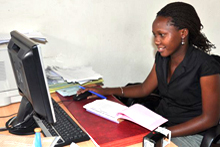
Ugandan health workerCapacityPlus works with the Uganda Ministry of Health to enhance workforce performance support, including field testing the project’s global rapid discrete choice experiment (DCE) tool to address attraction and retention of health worker cadres in rural and remote areas and a retention costing tool, iHRIS Retain. This is an excerpt from an original post on the IntraHealth International blog.

In Uganda there is only one doctor and 13 nurses to care for every 10,000 Ugandans, far short of the 23 health workers the World Health Organization recommends. Currently, only 56% of approved health worker posts are filled with qualified workers. Read more »

Without the User, There Is No System: Harnessing Technology through the eHealth Workforce

Dykki SettleThis post was originally published on the IntraHealth International blog.

When we talk about building strong health systems and the health workers to run these systems, we often think about doctors or nurses or community health workers. Just as crucial to health systems are robust health information systems that help manage and make accessible information about patients, clinics, budgets, payroll, and all the other details that make a health care system work.

When it comes to building a strong electronic health (eHealth) information system, the user is, arguably, the most important part.

Still weak, but growing
An eHealth workforce requires system administrators, programmers, and analysts who sustain and extend a country’s health information systems and eHealth technologies. Many countries in the developing world have growing but weak information and communication systems, which makes building the eHealth infrastructure system an ongoing challenge. Read more »

Showing Results in Health Workforce Strengthening

Crystal NgOpportunities to spend time with monitoring and evaluation (M&E) colleagues from other organizations are infrequent, yet they provide a valuable way to share knowledge and ideas. Recently, I attended a meeting of the USAID Bureau of Global Health Cooperating Agencies’ M&E Working Group. The meeting convened two USAID deputy assistant administrators, senior leadership from several Bureau of Global Health offices, and dozens of M&E staff from USAID-funded projects.

The meeting's objectives were to share updates on the Global Health Initiative (GHI) and the GHI’s best practices strategy (BEST) to discuss M&E technical issues. Not only was I impressed with the active participation of USAID leadership and their emphasis on the need for research and evaluation, but I was also interested to hear their views on the role of human resources for health (HRH) and M&E in implementing the GHI. Here’s what I took away from the day. Read more »

“With Technical Support You Learn to Fish”

Sarah DwyerWorking on the CapacityPlus project, I’m always excited to see capacity-building in action and hear how local leaders are strengthening the health workforce. Recently I learned about a terrific story from West Africa and wanted to help share it.

Building local ability to gather and use data
At the Health Information System Unconference in Accra, CapacityPlus’s Dykki Settle interviewed Kayode Odusote of the West African Health Organization (WAHO). Professor Odusote is helping WAHO’s member countries gather and use health worker data to make decisions about the health workforce.

In this piece from the CapacityPlus Voices series, Professor Odusote talks about a successful pilot in Ghana using iHRIS software. He emphasizes that the capacity-building aspect of WAHO’s partnership with our project is really what he values. “It’s a technical partnership,” he points out, “and basically for me that is much more than money. If you can build a core nucleus of local capacity,” he says, that has everything to do with sustainability. Read more »

Collaboration with Ugandan Students Expands Reach of Software Systems in the Health Sector

This post was originally published on the IntraHealth International blog.

Interns discuss HRIS data cleaning approachesWorking in the field of global health we often hear about the global health workforce shortage: we don’t have enough doctors, nurses, midwives, dentists, community health workers in developing countries. This is true, but what we hear less about is how we manage and support the people we do have, which is also crucial and one of the main charges of the Uganda Capacity Program.

One way the Uganda Capacity Program is helping to manage and support the current health workforce is through the development and rollout of the iHRIS software suite, an Open Source software solution developed under the USAID-funded and IntraHealth-led Capacity Project. Read more »

iHRIS in Kenya—The Key to Long-Term Sustainability

Brooke BuchananThe human resources information system (HRIS) implementation team for Capacity Kenya has championed the use of iHRIS software in Kenya. Because of their efforts we are excited to soon have a fully integrated system for human resources for health policy, planning, and management throughout the country.

Dr. Samwel Wakibi is now collaborating with the Ministry of Health and the Ministry of Public Health and Sanitation to ensure all human resources data for hiring, transferring, and retiring health workers are electronically entered into iHRIS by the Complement Section—the part the Human Resources Division within the Ministry of Health that handles all status changes for employed health workers, then sends these change orders to the Ministry of Public Service and then on to payroll. Read more »

Building Local Health Systems with Information Systems

This post was originally published on the IntraHealth International blog.

HRIS in IndiaOn my trip to India last month, I didn’t plan to focus on maternal health care, but walking through the maternity ward in Bihar, I couldn’t help but worry about the long lines and hours that keep a woman waiting to see a doctor. The health officials I met with are incredibly committed to serving their communities. In one case, I actually had to walk through the maternity ward to reach my meeting with members of the chief surgeon’s office and the head of district medicine. I realized these men and women walk by the patients every day—women like the proud new mother who urged me to come over and take a photograph of her new daughter. Although the hospital I was in is among the nicest in the state, it lacks many of the essential information systems that can make a health system run efficiently and effectively. In practical terms, this might mean the women I walked by would not have to spend so long waiting to be seen. Read more »

Syndicate content